
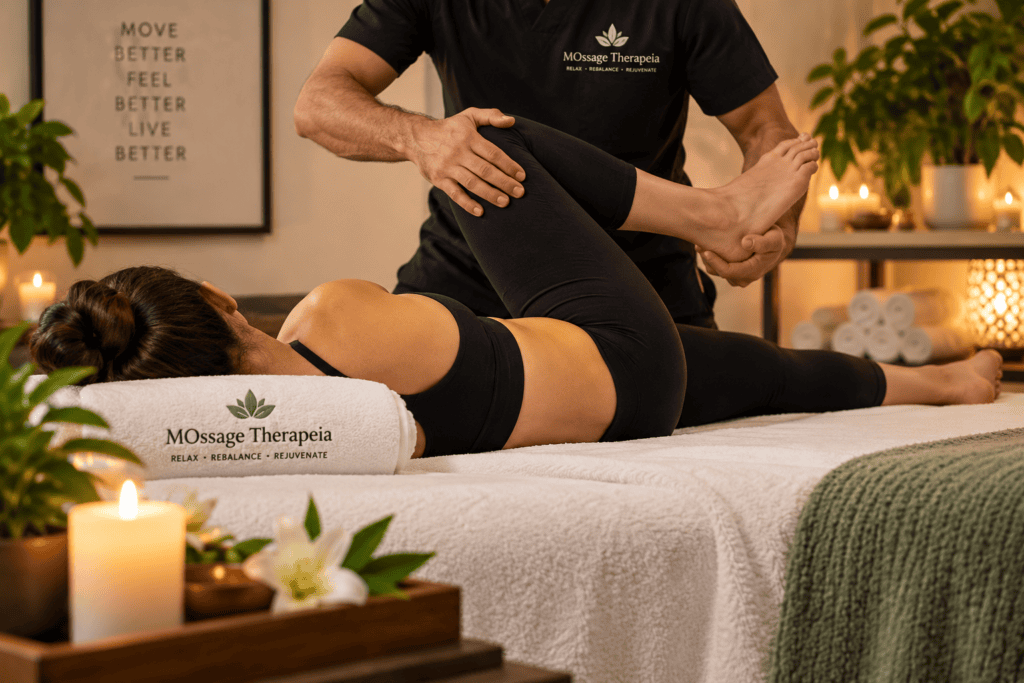
A professional massage therapist at MOssage Therapeia in Beverly Hills assisting a client with a guided stretch on the massage table, highlighting the synergy of stretching vs. massage for optimal mobility.

Stretching vs. Massage: Why Your Muscles Need Both for Optimal Mobility

When it comes to achieving true physical freedom and recovering from daily stiffness, the Stretching vs. Massage debate comes up often. Achieving true physical freedom and recovering from daily stiffness often sparks debate. Spending long hours at a desk, you have likely felt the deep, nagging restriction of tight muscles. Most people instinctively try to stretch away the pain, while others rely entirely on booking a spa day. However, treating these two modalities as an “either/or” scenario is a disservice to your body’s complex biomechanics.
1. Understanding the Mechanics: Active Elongation and Passive Manipulation

To understand the dynamic of Stretching vs. Massage, look at how your muscular system and nervous system works. Both respond differently to different types of physical stimuli. Both practices aim to increase your range of motion and decrease physical discomfort. They achieve these goals through entirely different physiological pathways.

Stretching is a form of active elongation. When you perform a stretch, you are intentionally pulling the origins and insertions of a muscle further apart. This signals your nervous system to gradually increase its stretch tolerance, allowing the muscle fibers to lengthen over time. It requires your active participation, mental focus, and consistent physical effort.

Massage, on the other hand, is a form of passive tissue manipulation. You are not actively forcing your muscles to lengthen; instead, a skilled therapist applies targeted external pressure. Massage focuses on the intricate webbing of fascia, muscle fibers, and connective tissue. It physically unglues areas that have become stuck together due to repetitive stress, poor posture, or acute injury. Understanding this distinction is the first step in realizing that one cannot fully replace the other.

2. The Role of Stretching: Lengthening Your Tissues and Building Flexibility

In the Stretching vs. Massage conversation, it is crucial to highlight exactly what stretching accomplishes. It’s just as important to note what its limitations are. A consistent stretching routine is the foundation of daily body maintenance.

incorporate both dynamic stretching and static stretching to lengthen the muscle into your routine. You train your central nervous system to allow a greater range of motion. Regular stretching helps to align collagen fibers in the muscles and tendons, improves your posture by preventing muscles from shortening. Also helps flush out metabolic waste after a grueling workout.

However, stretching has a major mechanical limitation when dealing with chronic pain. Imagine your muscle as a long piece of rope. If that rope has a tight knot right in the middle of it, what happens when you pull on both ends? The rope itself might stretch slightly, but the knot in the center is pulled even tighter. This is exactly what happens when you try to aggressively stretch a muscle that is plagued by myofascial adhesions. You end up overstretching the healthy, pliable muscle fibers at the ends. while the localized “knot” remains heavily contracted, leading to frustration and potential micro-tears.

3. The Power of Therapeutic Bodywork: Releasing Knots and Restoring Tissue Health

This brings us to the other half of the Stretching vs. Massage equation: the unparalleled power of professional therapeutic bodywork. When you have a “knot” in your muscle—technically known as a myofascial trigger point—stretching alone will not resolve it. These trigger points are areas of muscle tissue that are stuck in a continuous state of contraction, severely limiting local blood flow (a condition called ischemia) and causing localized or radiating pain.

Therapeutic massage is the necessary intervention to break down these physical barriers. At MOssage Therapeia in Beverly Hills, I utilize 17 years of clinical experience to accurately assess and isolate these areas of dysfunction. Through advanced modalities like deep tissue manipulation, cross-fiber friction, and targeted myofascial release, therapeutic massage physically breaks apart fibrous scar tissue and adhesions. The applied pressure forces fresh, oxygen-rich blood into the starved muscle tissues, flushing out stagnant cellular waste and instantly changing the texture and tone of the muscle.

Unlike a generic, cookie-cutter spa treatment, therapeutic bodywork is highly customized. It addresses the root cause of your limited mobility. A skilled therapist can manipulate the tissue in multiple directions, ungluing the fascial layers that restrict your movement. We essentially go in and manually untie the “knots” in your muscular rope, restoring the tissue to a healthy, pliable state that is finally ready to move freely.

4. The Synergistic Effect: Why You Need Both for True Mobility

The conversation shouldn’t be framed as a strict competition of Stretching vs. Massage. It’s better understood as a highly effective, synergistic partnership. To achieve optimal mobility, peak athletic performance, and a pain-free daily life, your muscles need both. That means combining active elongation with passive manipulation.

Think of therapeutic massage as the crucial “reset” button for your muscular system. When you visit MOssage Therapeia for a customized bodywork session, I break down the physical restrictions. I also restore proper sliding mechanics to your fascia. Once those adhesions are cleared, your muscles are primed and ready for stretching. Because the knots are gone, your at-home stretching routine becomes exponentially more effective. The entire length of the muscle can now elongate evenly and safely. Allowing you to achieve deeper stretches without the pain of pulling against a restriction.

Conversely, maintaining a daily stretching routine helps prolong the benefits of your massage therapy sessions. keeping your muscles lengthened and your joints mobile between appointments, you prevent new adhesions from forming as quickly. This means that during your next massage session, we don’t have to start from square one. Instead of fighting through superficial tension, i can address deeper, more chronic issues. This accelerates your journey toward total well-being.

Reclaim Your Mobility with MOssage Therapeia in Beverly Hills

Instead of choosing sides in the Stretching vs. Massage debate, embrace the holistic approach that your body desperately needs. You supply the daily stretching, and let MOssage Therapeia to provide the expert therapeutic intervention. Together, this keeps your tissues healthy, balanced, and pain-free.

With over 20 years of dedicated experience, MOssage Therapeia is the premier destination for personalized bodywork in Beverly Hills. I specialize in identifying the unique structural imbalances holding you back. My care is designed to support your mobility, reduce your stress, and elevate your total well-being. Proudly serving clients throughout Beverly Hills, West Hollywood, Los Angeles, Culver City, and Santa Monica. I am here to help you feel restored and renewed.

Stop letting chronic tightness dictate your lifestyle. Experience the profound difference that expert therapeutic massage can make in your mobility and overall health. Book your customized appointment with MOssage Therapeia today, and take the ultimate step toward a balanced, pain-free life.

Leave a Comment

Your email address will not be published. Required fields are marked *