
Countless people search for the secret to fix lower back pain. If that’s you, you already know how deeply it can affect daily life. A dull constant ache during meetings or a sharp twinge when tying your shoes, lower back pain is incredibly debilitating. It drains your energy, sours your mood, and limits your ability to enjoy the vibrant Los Angeles lifestyle. However, your body is not attacking you randomly; pain is a sophisticated communication tool. Your lower back is telling you something-your alignment, daily habits or emotional state maybe out of balance.
In this guide, we will explore the physical root causes behind your lumbar discomfort. We will also look at how chronic stress tightens your posterior chain. We also explain why temporary symptom-management often falls short-and how personalized therapeutic bodywork at MOssage Therapeia can provide lasting relief.
1. The Mechanical Root Causes Behind Your Discomfort
The first step fixing lower back pain is understanding that the site of the pain is rarely its source. Your lower back, or lumbar spine, is essentially the central crossroad of your body’s structural forces. It bears the weight of your upper body while acting as the pivot point for your legs. It’s highly vulnerable to imbalances happening above and below.
For most professionals living in Southern California, the root cause is environmental: we simply sit too much. Whether you are hunched over a laptop or stuck in traffic during your commute. Either way, prolong sitting Over time can severely compromises your biomechanics.
They become locked in a state of continuous, exhausting contraction. Furthermore, sitting deactivates your gluteal muscles, forcing your lower back to take over the job of stabilizing your pelvis. Until these tight hip flexors are released and the structural balance of your pelvis is restored. Your lower back will continue to suffer the consequences of this mechanical tug-of-war.
2. How Emotional Stress Physically Tightens Your Lumbar Region
The psychological and neurological element of fixing lower back pain is often completely ignored by traditional medical approaches. It is one of the most critical factors in chronic discomfort. The mind-body connection is not just a wellness buzzword; it is a very real, tangible physiological process. Your body carries the weight of your emotional stress. For many people, the lower back is the primary dumping ground for this tension.
Stress can come from work deadlines, financial worries, or relationship friction. Your sympathetic nervous system responds by activating ‘fight-flight’ mode. This evolutionary mechanism floods your system with cortisol and adrenaline, preparing your body to physically fight or run away. To do this, your brain signals your major muscle groups, particularly your core and lower back to brace for impact.
If this stress is chronic, your lower back muscles never receive the signal to stand down. They remain in a low-grade state of guarding. Additionally, high stress severely alters your breathing patterns. You begin to take shallow, rapid breaths into your upper chest rather than deep, diaphragmatic breaths into your belly. The diaphragm is closely connected to the muscles of the lumbar spine. when it doesn’t move fully, the lower back muscles are deprived of their natural position and become rigid. Addressing this nervous system activation is absolutely essential to unlocking a stiff, painful lumbar region.
3. Why Temporary Solutions and Quick Fixes Fall Short
There is a crucial realization in fixing lower back pain. Simply managing the symptoms is not the same as correcting the underlying dysfunction. When lower back pain strikes, most people reach for the fastest available relief. You might swallow over-the-counter anti-inflammatory medications, using a heating pad or try a generic massage gun. Maybe you’ve attempted random stretches from YouTube.
While these methods can offer a temporary relief, they fail to address the root causes we discussed above. Painkillers numb the alarm bell, but they do not put out the fire. Once the medication wears off, the mechanical imbalance and tight hip flexors are still pulling on your spine. Heating pads draw blood to the surface of the skin, which feels soothing. But the heat rarely penetrates deeply enough to release a chronic myofascial adhesion buried deep within your quadratus lumborum.
Generic stretching can actually make the problem worse if done incorrectly. Stretching a muscle that is locked down by trigger points will only overstretch the healthy tissue. If you aggressively stretch to touch your toes, you might sprain the ligaments stabilizing your pelvic. True healing requires a targeted, expert intervention that physically changes the soft tissue’s state. It’s not just masking the discomfort for a few hours.
4. The MOssage Therapeia Approach to Lasting Relief
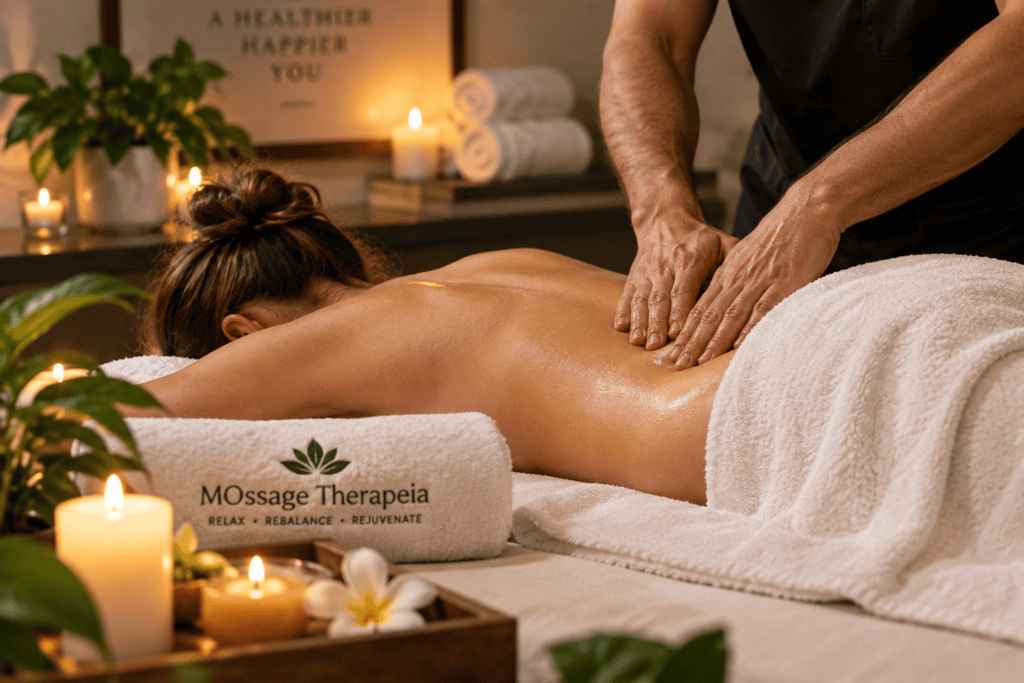
At MOssage Therapeia, fixing lower back pain is achieved through a highly tailored, clinical approach. It’s not a one-size-fits-all spa routine. With over 20 years of hands-on experience, I understand that your back pain is as unique as your fingerprint. When you walk into my Beverly Hills studio, i don’t just treat the symptom. I investigate the entire biomechanical chain to find out exactly why your lower back is screaming for help.
I use advanced therapeutic modalities, including deep-tissue manipulation, precise trigger-point therapy. Customized myofascial release also helps systematically relieve tension. I focus on releasing tight hip flexors pulling on your pelvis, and ungluing fascial layers in your lower and mid-back.
This personalized bodywork physically breaks down the fibrotic scar tissue and adhesions that are restricting your movement. Furthermore, the therapeutic touch profoundly calms your central nervous system, shifting you out of the “fight-or-flight” state. I reset your body’s structural alignment and nervous system simultaneously. This gives your lower back the optimal environment it needs to heal, repair, and function pain-free.
Reclaim Your Active Lifestyle in Beverly Hills
You do not have to accept a life limited by chronic discomfort. Your body wants to move freely, and your lower back pain is a request for the right kind of help. Understanding your daily mechanical imbalances and the physical toll of emotional stress. Then you can move past temporary band-aids and truly resolve your pain at its source.
Ready to finally prioritize fixing lower back pain. it is time to book your personalized therapeutic session at MOssage Therapeia. Proudly serving Beverly Hills, West Hollywood, Los Angeles, Culver City, and Santa Monica. I am dedicated to providing the expert, compassionate care you need to restore your mobility and total well-being. Stop letting back pain dictate your life, schedule your appointment today and take the first step toward a pain-free body.